Afghanistan on $3.84 per Day per Person - Part 1
by
Ray and Hannelore Heizer
|
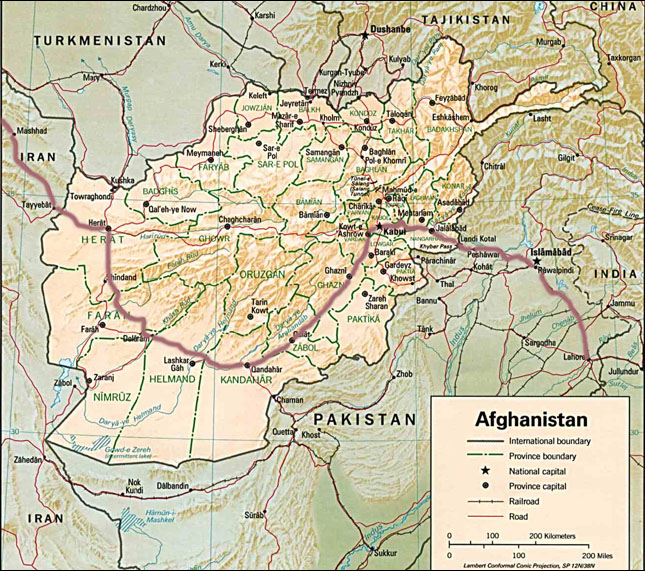
In November 1967 we, then in our early 20's and Peace Corps volunteers in Yazd, Iran, traveled from Iran through Afghanistan, Pakistan and India to Nepal. Modes of transportation included trains, buses, cars, a truck, hitchhiking, donkey carts, rickshaws, normal taxis, motor scooter taxis, horse-drawn taxis, a ferry boat, and a hike across "no man's land" between Pakistan and India since they were then at war.
This three-part narrative is drawn from the diaries of the trip which we both kept along the way and covers the trip from Mashad, in eastern Iran, through Afghanistan to Peshawar, Pakistan. We have interspersed some scans of slides and photographs we made.
Local prices from our expense log have been converted to 1967 dollars and inserted into the text.
Observations about the land and its people are those we made at the time. 10-3-01 | 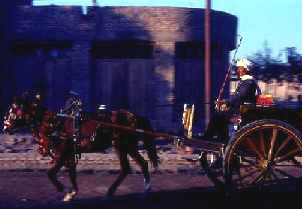
|
November 9, 1967 - Mashad, Iran, to Tayyebat, Iran
Arriving by train from Teheran about 7 a.m., we woke up our friend, Bill Carter, a local Peace Corps volunteer, at his home about 7:30 a.m. Bill had met an American couple, Laura and Oliver Popenoe, the night before. They were leaving today for Herat, so we went out to see if we could find them. Luckily we saw their car in front of the Bank Melli and they agreed to take us with them. We had tea, fixed the bumper on their car, picked up Hannelore who was washing clothes at Bill's and took off for the bazaar.At the bazaar we got money changed, some souvenirs, rained upon, and kicked out of the Holy Shrine area by the Religious Police. After first leaving town in the wrong direction, we were finally on our way. The Popenoes are interesting people - four years on the Peace Corps staff (two in Malaysia), now living in London where he attends the London School of Economics. They are on their way to Kuala Lampur for a year of research.
Their car (a British Bedford Dormobile) is not built, suspension-wise, for the badly corrugated roads of Iran, but it is an excellent camping rig.
We missed the turnoff for Tayyebat and had to go back 18 km. About 4:30 in the afternoon a tremendous clang arose from the motor. The motor mount had come unbolted. So we jacked up the motor and took off the rear bumper to use its bolts on the motor ... about 1/2 hour lost. Later the same type of sounds again! But this time, thank God, only the license plate had come loose and was dragging.
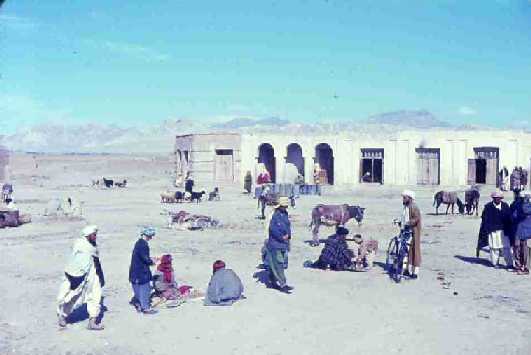
Tayyebat border station in Iran. Many of these men are Afghani.
We arrived in Tayyebat about 7 p.m. and started the border formalities. Hannelore had no Iranian entry stamp in her passport and it looked like a long wait while they contacted Teheran the next day (since this was a mistake/omission made upon her arrival at the Teheran airport), but with pleadings, charm, and veiled threats we won over the nice man who gave her an exit stamp and ripped up her landing card which should have been sent to Teheran upon exiting Iran.
After a visit to the secret police office, we got a room at the "Tayyebat Hilton" ($.79) because the border had closed for the day at 8 p.m., and we finally had our first meal of the day - tea and eggs ($.71). Our bed was so dirty we slept on the floor in our sleeping bags.
The Popenoes were allowed to sleep in their car in the customs office court yard.
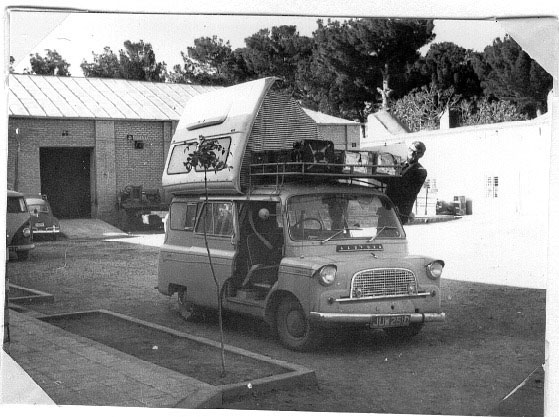
Oliver Popenoe and his rig in the Tayyebat Customs Office court yard.
November 10, 1967 - Tayyebat, Iran to Herat, Afghanistan
The Iranian formalities were completed without further delay and we left about 8 a.m. taking a very nice Swedish hitchhiker with us. We drove about half an hour through a sort of "no man's land" to the Afghan frontier. Hannelore had no entry card, but a couple of smiles produced one for her to fill in. And in return for the "personal gift" of one of her extra passport photos, the officer also stamped her passport. In the customs office we were treated to French cigarettes and a man who was pleased to be able to exercise his passable German. We also picked up another traveler, a Japanese fellow the Popenoes had met several times previously along the road. After some tea, we started out for Herat.
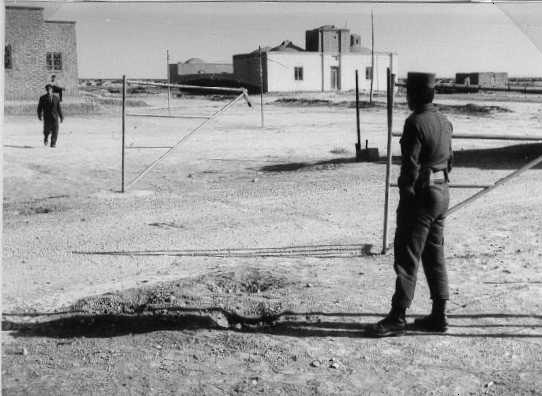
Iranian border gate to "no man's land."
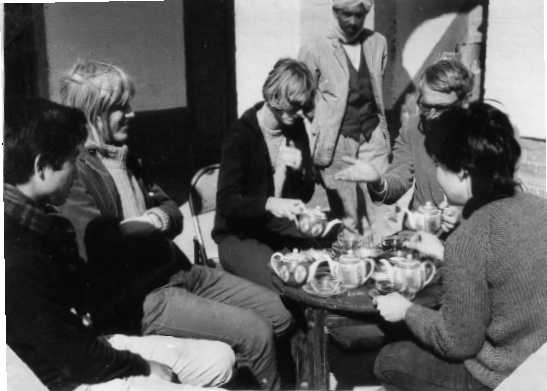
Tea at the Afghani border station. From left: Japanese hitchhiker, Swedish hitchhiker,
Hannelore pouring tea, tea boy, Oliver and Laura Popenoe.
The road was excellent and a different type of dress was immediately noticeable (Iranian law dictates that men wear "western" clothes) - the Afghani men were wearing desert garb, baggy pants, turbans, and colorful coats. We had a flat tire about half way to Herat, but it was quickly changed.
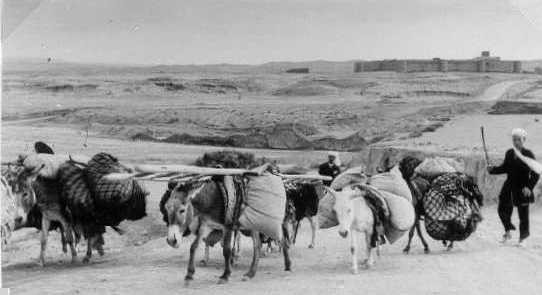
Along the road into Herat. The large building in the background is probably a caravansari,
a traditional overnight place for caravans along these trade routes in the past.
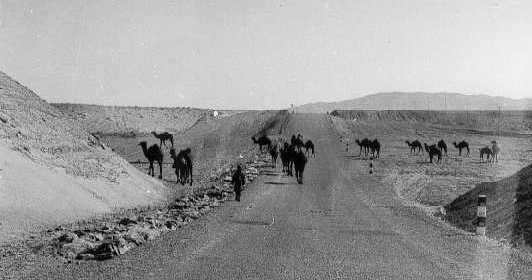
Camels along the road into Herat from the border.
We arrived in Herat about 2 p.m. (there was a one hour time change at the border), and immediately got a room at the Behzad Hotel ($1.11) and had lunch ($.69). Next we bought bus tickets for the next morning for the trip to Kandahar and Kabul ($3.60 each for the two-day, 650 mile trip). We walked around the bazaar, and saw the beautiful mosque with imaginative and intricate mosaics.
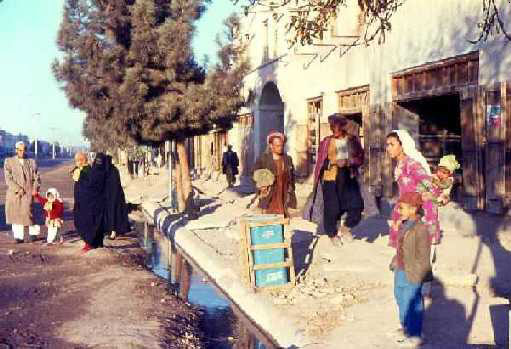
Storefronts on Heart's main street. Bedouin tribal women usually do not wear veils.
The water is an open sewer, typical for mid-sized towns.
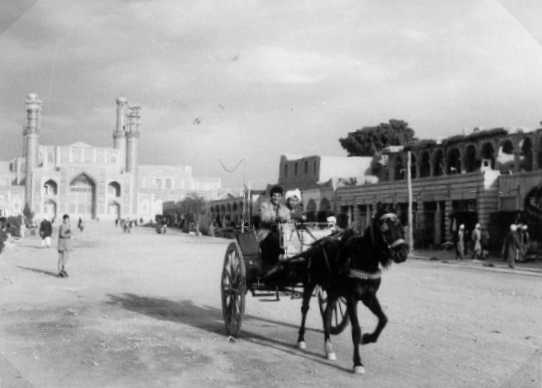
Horse-drawn taxi on the main street in downtown Herat.
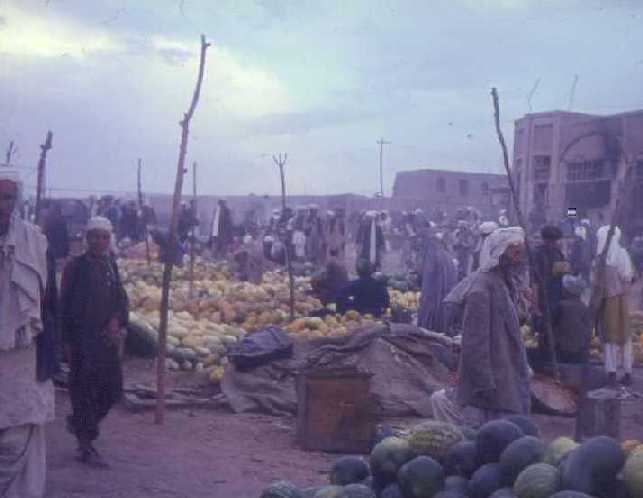
Friday evening fruit market. The Bedouins bring their fruit to the market in Heart.
The poles hold tent coverings during the hot sun or rain.
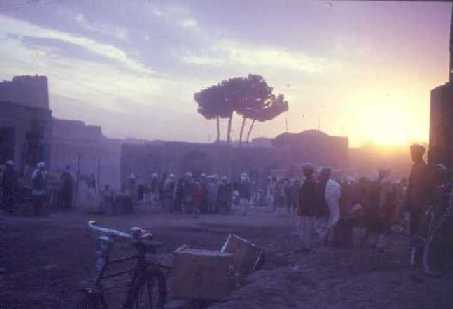
Fruit market at sunset in Herat.
Finally, we went out at sunset in a horse-drawn droshka to an old ruined mosque. The domes, minarets and people outlined against the sky were an age-old scene - the way we had always pictured the middle east.
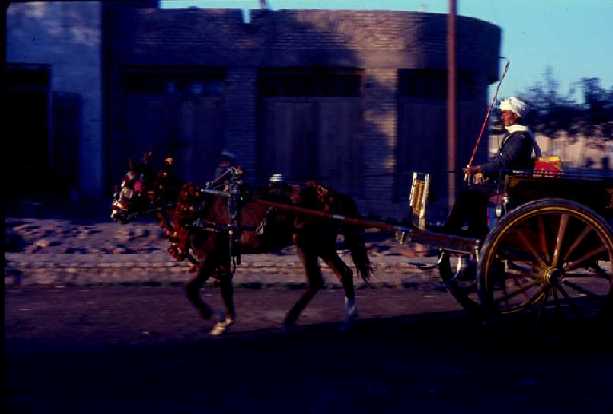
Rickshaw for the rich in Heart. The Afghans were proud people. They like horses more than camels.
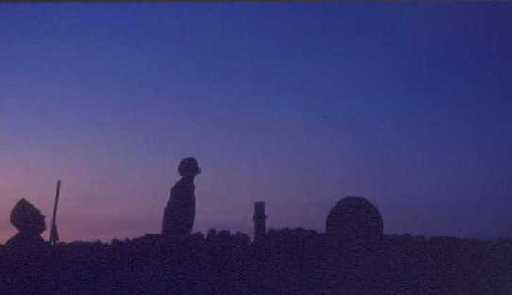
Near an old mosque at sunset. The men in the mountains always have rifles. They are great hunters.
We said our goodbyes to the Popenoes and had dinner ($.83) with a very nice couple from Berlin who are on their way to Japan on a BMW600 motorcycle with a sidecar.
First impressions of Afghanistan as compared to Iran ... very cheap prices, the different dress, different facial characteristics of the people, better food, less developed. Herat has 150,000 people, but is really like an extended village.
We got a bucket of hot water from the hotel management to wash up rather than brave their cold showers before going to bed.
November 11, 1967 - Herat to Kandahar
We got up at 6:30, had a quick breakfast ($.34), and went on down to the bus station. Due to the time change and the season, the sun rose too late to photograph the mosaics in the mosque. The bus finally got started about 8.
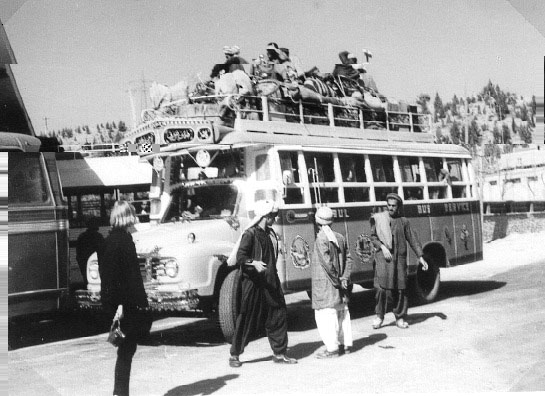
A very typical bus that is the main connection between major towns and the villages in
Afghanistan. Hannelore watches in the foreground.
The buses are a gift from CARE -- American made school buses. The road is excellent concrete, but the bus springs are a little stiff, and the original seats have been replaced by wooden benches facing sideways. But we are making good time, so no complaints. We saw several nice buildings built by the Russians along the road .. hotels, gas stations ...
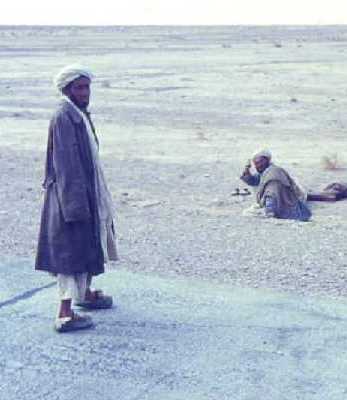
Waiting for a ride, saying hello, and praying.
In five hours on this, the main road in Afghanistan, and the main road connecting Europe and India, we have encountered only one other vehicle, going the opposite way - a bus from the same company as our bus!
Our bus stopped for lunch ($.42) in Delaram, and we ate with two Swedish Peace Corps volunteers from Rasht, Iran. The countryside is rugged, desert, small mountains, no trees. Lots of nomads and grazing camels along the side of the road.
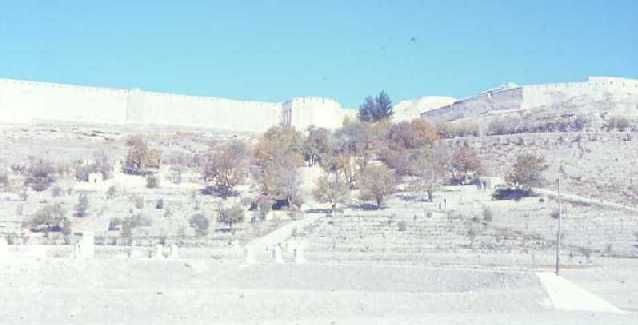
A fortress near Kandahar.
No further excitement until Kandahar about 5:30 p.m. Kandahar is at the northern edge of a great sand desert. There is a sharp line dividing the desert from the tundra type land we were on. The town stretches along the edge of the desert for about 20 miles like a snake. We drove and drove for about 1/2 an hour before coming to the center of the city. The Kandahar Hotel ($.96) is clean and spacious.
We walked through the bazaar, bought nuts, raisins, grapes and a pomegranate, then had dinner of eggs and tea ($.40) at a very native restaurant - smoke pouring from the stove, loud oriental music, men in robes and turbans, dimly lit. We got here after dark and the street lighting is very weak, giving the whole scene a feeling of intrigue, mystery and eeriness. 100 years ago it must have been 90% the same ... Kandahar is as far removed from Iran as Iran is from NYC! The women all wear tent-like "chadris" with a net to see out of over their faces. The men are swarthy, tall, thin and very handsome, with moustaches, and/or beards, and their turbans wrapped around their heads and hanging down to be used as scarves. A proud people but not arrogant as are the Iranians. Other differences: cleanliness, children seem happier, parents playing with their kids.